
EV green number plates are UK registration plates with a green flash on the left side that identify a vehicle as fully electric. They are available for eligible zero-emission vehicles and are not required by law for every electric car. This guide explains who can use one, which vehicles qualify, how the rules work, and whether fitting a green plate offers any practical benefit.
Key takeaways
- Green number plates are only for fully electric vehicles, not hybrids or plug-in hybrids.
- You do not need a green plate by law to drive or register an EV.
- The plate uses a green flash on the left side, beside the standard registration.
- Eligible drivers can order green number plates through registered number plate suppliers.
- Green plates help councils and parking operators identify EVs for local incentives.
- Benefits linked to green plates vary by area, so check local rules before ordering.
What EV green number plates are and how they differ from standard plates
Sources: Motor1 / AA Research (2021); Autotrader (2025); Parkers / YouGov–Nissan (2023)
Check your V5C logbook before ordering a green number plate, because only vehicles registered as zero-emission qualify. In the UK, that means battery electric vehicles and hydrogen fuel cell vehicles. Plug-in hybrids and conventional hybrids do not qualify, even if they can drive short distances on electric power.
The plate uses the same registration number format as a standard UK plate, with a green flash on the left-hand side. The rest of the plate must still meet the legal rules on font, spacing, reflectivity and supplier details set by the DVLA and GOV.UK guidance. You cannot add a green flash to an existing plate yourself if the finished plate does not meet those standards.
In daily use, the green panel does not change the registration itself. It acts as a visual marker that the vehicle is fully zero-emission. Local authorities can use that marker when they offer EV-only parking, lane access or fee discounts, although any benefit depends on local rules rather than the plate alone.
Which vehicles qualify for a green number plate in the UK
| Vehicle Type | Qualifies for Green Plate? | Reason |
|---|---|---|
| Battery Electric Car (BEV) | ✅ Yes | Zero tailpipe emissions; DVLA records as zero-emission |
| Hydrogen Fuel Cell Vehicle | ✅ Yes | Zero tailpipe emissions (emits only water vapour) |
| Zero-Emission Van / Motorcycle / Bus | ✅ Yes | All vehicle classes eligible if fully zero-emission |
| Plug-in Hybrid (PHEV) | ❌ No | Has an internal combustion engine; not zero-emission |
| Self-Charging Hybrid (HEV) | ❌ No | Produces tailpipe emissions; not zero-emission |
| Mild Hybrid (MHEV) | ❌ No | Petrol/diesel engine remains; not zero-emission |
| Low-Emission Petrol / Diesel | ❌ No | Still produces tailpipe emissions; not eligible |
Source: Autotrader – Green Number Plates Guide (2025); GOV.UK – Green Number Plates Announcement (2020)
Ordering the wrong plate can lead to a failed order or a plate that cannot be fitted legally, so check eligibility before you buy. Rely on the vehicle’s official registration record, not the fuel type shown in adverts or dealer listings.
In the UK, a green number plate is reserved for vehicles recorded as zero-emission by the DVLA. That includes fully electric cars, vans, motorcycles and hydrogen fuel cell vehicles. If the vehicle has any tailpipe emissions, it does not qualify, even if it can run on electric power for part of a journey.
The DVLA record is what plate suppliers use to check whether they can issue a green flash plate. That removes guesswork around mild hybrids, self-charging hybrids and plug-in hybrids, which are not eligible.
If the V5C is missing or the vehicle has just been registered, check the seller’s paperwork or the manufacturer’s specifications, then match that against the DVLA record once it appears. If the registration details are wrong, correct them before ordering.
Whether EV drivers need a green number plate or can use a standard plate
Do not assume a green number plate is required once a vehicle qualifies, because UK rules make it optional. An eligible vehicle can still use a standard plate if it meets the legal rules on size, spacing, font and visibility set out by GOV.UK.
The registration mark stays the same. Only the coloured flash at the left edge changes. A registered number plate supplier can produce either a standard plate or a green plate for a qualifying zero-emission vehicle, and that choice does not alter the vehicle’s tax class, registration status or DVLA record.
The green flash is only a visual identifier, not a separate registration category or a permit drivers must apply for. If a vehicle is not recorded correctly with the DVLA, fitting a green plate does not make it eligible.
Eligible EV drivers may use a green plate to show zero-emission status, but they can also keep a standard plate. The fitted plate must match the registration record and comply with UK number plate law.
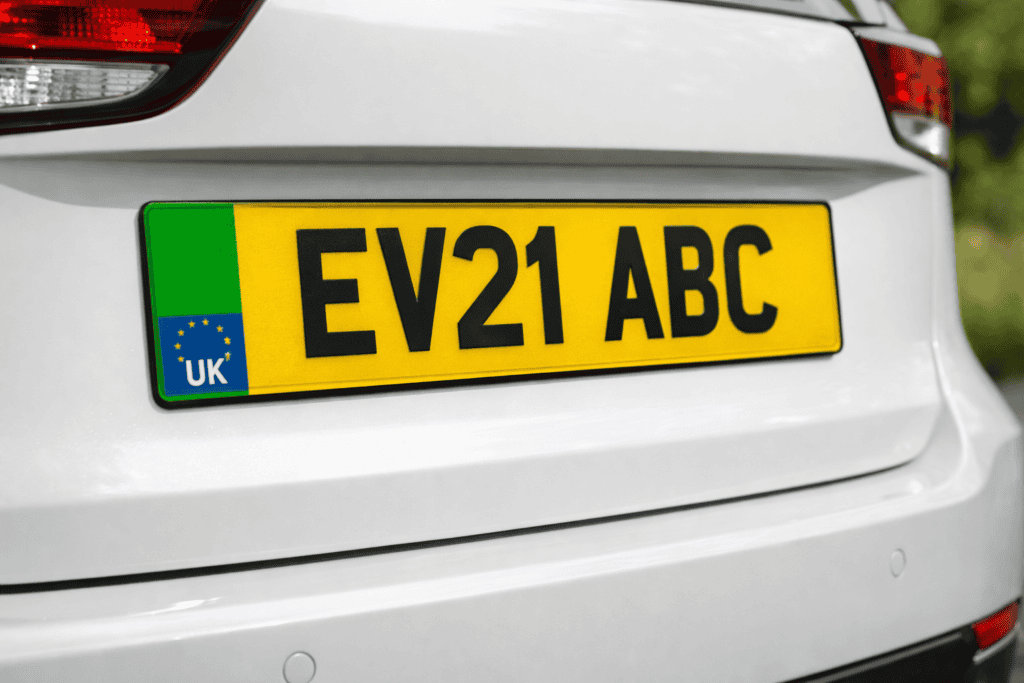
How to get a green number plate fitted legally
Use a registered number plate supplier, because only they can issue a road-legal green plate. Take the vehicle’s V5C logbook or other accepted proof of entitlement, plus photo ID and proof of address if asked. Ask for a plate that follows DVLA display rules on font, spacing, reflectivity and the green flash.
Check the finished plate before fitting. The registration must match the V5C exactly, including spacing, and the supplier’s name and postcode plus the British Standard mark must appear where required. Fit it securely in the standard front and rear positions, keep it visible, and do not cover it with tinted covers or frames that hide any character.
Avoid common mistakes. Do not buy a novelty plate online without checking the seller is registered. Do not alter spacing to make the registration look like a word. Do not add badges, screws or trims that make characters harder to read. Replace any plate that is cracked, faded or delaminating with another compliant plate.
What practical benefits green number plates offer and where limits apply
Clear local policy benefits become easier to access when a vehicle displays a green number plate, but the plate itself does not create any automatic right. UK rules allow councils and transport authorities to recognise zero-emission vehicles more easily, which is why green plates were introduced. In practice, any benefit depends on a separate local scheme, not on the plate alone.
That means the main value is visibility. A green flash can help enforcement teams, parking staff and traffic officers identify eligible vehicles without checking fuel type from scratch. Some authorities have used green plates to support incentives such as cheaper parking or access measures, but those schemes vary by area and can change.
The limits are just as important. A green number plate does not replace permits, payment, congestion rules or clean air zone requirements. It also does not prove exemption where a camera-based system relies on the DVLA vehicle record instead of plate colour. Check the relevant council or scheme operator before relying on the plate for any practical advantage.
Frequently Asked Questions
What are EV green number plates in the UK?
EV green number plates are UK number plates with a green flash on the left side, used only on fully electric vehicles. They show that a vehicle produces zero tailpipe emissions. The mark can help local authorities identify EVs for incentives such as cheaper parking or access to low-emission schemes.
Who is eligible to use a green number plate?
Only zero-emission vehicles can use a green number plate. That includes fully electric cars, vans, motorcycles and hydrogen fuel cell vehicles registered with the DVLA.
Plug-in hybrids, mild hybrids and standard petrol or diesel vehicles are not eligible. The plate is optional, not a legal requirement.
Are green number plates mandatory for electric vehicles?
Check the current DVLA rules before ordering one. Green number plates are not mandatory for electric vehicles in the UK; they are optional for eligible zero-emission vehicles. They help identify EVs and may support access to local incentives, but you can still drive legally without one.
Can hybrid vehicles have green number plates?
Only vehicles that can drive with zero tailpipe emissions qualify. Most hybrid vehicles, including standard and mild hybrids, cannot have green number plates.
Plug-in hybrids also do not qualify under current UK rules. Green plates are reserved for fully electric vehicles, hydrogen fuel cell vehicles, and a small number of other zero-emission models.
What are the benefits of having a green number plate?
Introduced in the UK in December 2020, green number plates mark a vehicle as fully electric. That can help drivers access local incentives, such as cheaper parking or entry to low-emission zones where councils allow it. They also make the car’s zero-emission status clear at a glance.
How can you get a green number plate for your vehicle?
Order a green number plate from a registered number plate supplier once your vehicle is classed as zero-emission. You will need proof of identity, proof of entitlement to use the registration number, and the vehicle’s details. The supplier adds the green flash on the left side of the plate.
Do green number plates apply to all electric vehicles, including vans and motorcycles?
No. Green number plates apply to zero-emission vehicles, not every vehicle with an electric or hybrid element. That includes eligible fully electric cars, vans and motorcycles registered in the UK. Hybrids, plug-in hybrids and any vehicle with tailpipe emissions do not qualify.