
UK number plate rules set strict standards for font, character spacing, plate size, and materials to keep vehicles identifiable in traffic and by enforcement cameras. The regulations specify a fixed typeface, minimum character height and stroke width, and defined margins between letters, numbers, and the plate edge. Plates must use reflective materials and display the correct colours for front and rear fitment. Non-compliant plates can trigger MOT failures, fines, and registration withdrawal.
Key takeaways
- UK plates must use the Charles Wright 2001 font for legal road use.
- Standard character height is 79mm, with 50mm width for most letters.
- Stroke width must be 14mm, with 11mm spacing between characters.
- Group spacing between the two registration halves must be 33mm.
- Front plates must display black characters on white; rear plates use yellow.
- Plates must be reflective and made from durable acrylic or approved materials.
UK Road-Legal Number Plate Font and Character Rules (Charles Wright, Stroke Width, 3D/4D Styles)
UK law fixes character dimensions tightly: standard registration marks must use 79 mm tall characters, a 50 mm character width (except “1” and “I”), and a 14 mm stroke width. The rules also require 11 mm spacing between characters and 33 mm between the two groups, with a 11 mm margin around the plate. These measurements reduce misreads by ANPR (automatic number plate recognition) cameras, which police forces and local authorities use to enforce vehicle excise duty, insurance, and road charging.
The required typeface is Charles Wright, specified in the British Standard for number plates. Any font variant that changes the stroke profile, character width, or internal gaps can make a plate non-compliant, even if the registration remains legible to a person. DVLA guidance also restricts “3D” and “4D” styles: raised or gel characters can remain legal only when the printed character shape, spacing, and contrast match the standard, with no shading, outlines, or patterned effects that alter the character edge.
For the most current compliance checks, use the DVLA rules on displaying number plates. For practical ordering guidance, see the Ultimate Number Plate Guide.
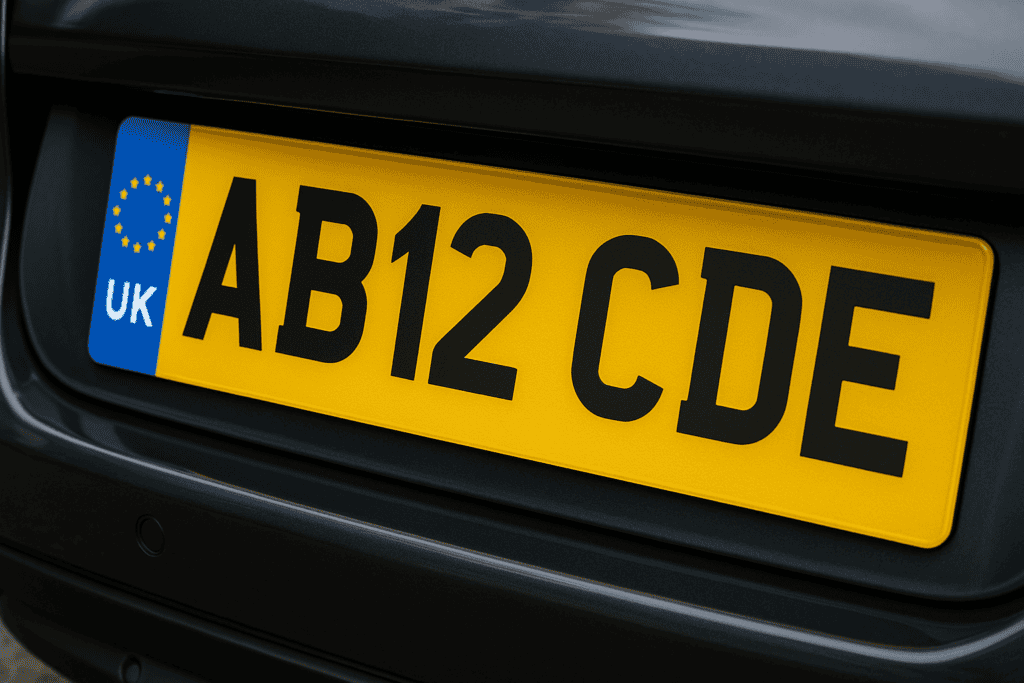
Mandatory Spacing, Margins, and Layout for Registration Marks (Front vs Rear, GB/UK Identifiers)
A driver orders a replacement rear plate and asks for a smaller margin to fit a tight recess. The plate arrives, but the registration sits too close to the edge and the car fails a roadside check because the layout no longer meets the required border and identifier rules.
UK plates must keep a clear margin around the registration and maintain a clean, rectangular layout so ANPR can isolate the characters from the background. The front plate must display black characters on a white reflective background, while the rear must use black on yellow. If a GB/UK identifier appears, it must sit in a separate vertical band at the left edge and must not crowd the registration or reduce the required margins.
Apply the same approach to any format, including shorter registrations: keep the registration centred, preserve the border, and avoid squeezing characters to “make it fit”. For a practical walkthrough of compliant layouts, see the Ultimate Number Plate Guide.
Legal Number Plate Sizes and Format by Vehicle Type (Cars, Motorcycles, Imports, Towing)
Cars and light vans usually use the full-size rectangular plate, while motorcycles and some imports need smaller formats to fit mounting points. UK law sets different legal sizes by vehicle type, and enforcement focuses on whether the plate remains readable and correctly proportioned for ANPR.
| Vehicle type | Common legal plate size (mm) | Format notes |
|---|---|---|
| Cars and light vans | 520 × 111 | Standard long plate; front must be white, rear yellow. |
| Motorcycles | 230 × 178 | Rear plate only; typically two-line layout. |
| Imports (space-limited) | Varies (smaller permitted) | Smaller plate allowed only where the vehicle cannot physically take 520 × 111. |
| Towing (trailers, caravans) | Matches towing vehicle | Must display the towing vehicle registration on the rear of the trailer. |
Option A involves fitting the standard 520 × 111 plate wherever possible; Option B uses an approved smaller plate when the bodywork prevents the standard size. The practical implication is simple: a “short” plate that fits a recess but reduces legibility can trigger roadside action and a failed inspection. For baseline dimensions and exceptions, check GOV.UK number plate rules.
Approved Materials, Reflectivity, and Supplier Compliance (BS AU 145e, BSAU Marking, Fixings)
Non-compliant materials cause measurable enforcement problems: ANPR systems rely on consistent retroreflectivity, and plates that scatter light or crack around fixings can trigger misreads and roadside stops. In the UK, suppliers must manufacture plates to The Road Vehicles (Display of Registration Marks) Regulations 2001 and the British Standard BSI specification BS AU 145e, which sets durability and performance expectations for the reflective face.
Use a plate that carries the required markings: the British Standard reference (often shown as “BSAU 145e”) and the supplier’s name and postcode. These markings confirm traceability, which matters when police or MOT testers question a plate’s origin. For reflectivity, the front plate must present a white reflective background and the rear must present a yellow reflective background; both must remain readable under headlamp illumination and in daylight.
To implement this correctly, order from a registered supplier and confirm the finished plate includes the BSAU marking and supplier details before fitting. Fit plates using fixings that do not obscure or distort any character; avoid bolts through strokes and avoid tinted covers, which can reduce reflectance and create glare. When drilling is unavoidable, place holes in blank areas and use colour-matched caps to preserve contrast.
When you follow BS AU 145e material and marking requirements, plates resist cracking, delamination, and fading over normal service life, and ANPR reads remain consistent. If you need a compliant supplier route, where can i get provides a practical starting point.
Frequently Asked Questions
Which font must UK road-legal number plates use, and are 3D or gel fonts permitted?
UK road-legal number plates must use the standard Charles Wright font (the prescribed “number plate font”). 3D, gel, and raised characters are permitted if the font shape, stroke width, spacing, and character sizes remain compliant and the plate stays clearly legible. Stylised fonts, italics, or altered character shapes are illegal.
What are the legal character height, width, stroke thickness, and spacing requirements for UK number plates?
For UK cars and light vans, characters must be 79mm high, 50mm wide (except “1” or “I”), with a 14mm stroke. Spacing must be 11mm between characters, 33mm between the two groups, and a 11mm margin around the plate. Standard plate size is 520mm × 111mm.
What are the standard front and rear number plate sizes for cars, and when are smaller plates allowed?
Standard UK car plates measure 520mm × 111mm (front and rear). A smaller plate is allowed only when the vehicle cannot physically accommodate the standard size, such as some imported cars, classic vehicles, or models with limited mounting space. The plate must still use the legal font, character size, spacing, and margins.
Which number plate materials and reflective backgrounds meet UK road-legal requirements?
UK road-legal plates must use a reflective background: white on the front and yellow on the rear. Plates should use durable, weather-resistant materials such as acrylic or polycarbonate, with black, non-reflective characters. The background must stay reflective and legible in rain and low light, without patterned or tinted finishes.
What supplier details and British Standard markings must appear on a road-legal number plate?
A road-legal number plate must show the supplier name and postcode, plus the British Standard mark. For plates made to the current standard, this appears as “BS AU 145e”. Plates made to older standards may show “BS AU 145d”. The markings must be permanent, legible, and placed on the bottom margin.
Can I legally use tinted, coloured, honeycomb, or carbon-style number plates on UK roads?
Usually no. UK road-legal plates must use black characters on a white front plate and yellow rear plate, with a plain reflective background. Tinted, coloured, honeycomb, and carbon-style finishes often reduce reflectivity or add patterns, which can make plates non-compliant. Police can issue fines and require replacement plates.
What are the likely penalties and MOT outcomes for non-compliant number plates?
Non-compliant number plates can trigger a £100 fixed penalty notice, and police can issue a Vehicle Defect Rectification Notice requiring replacement within 14 days. Serious cases may lead to prosecution and higher fines. At MOT, a plate that is missing, insecure, illegible, or uses incorrect characters will fail.